
For a first mandala, look at the spaces you will actually color, not only the beauty of the finished pattern. A design can appear simple from a distance while containing many narrow sections. Another may look elaborate but repeat the same clear shapes around the center. The second can be easier to follow because each repetition gives you a familiar next step.
People searching for mandala coloring pages may want printable outlines, free coloring or a numbered digital pattern. These are different activities. This guide uses existing artwork from Mandalia, an Artia Club app, to explain how to choose and approach a pattern. It does not promise that the app provides printable files or that coloring has a medical effect. The useful question is whether the design suits the kind of quiet creative time you want today.
Inspect the smallest spaces
Open the preview and look near the center, where many lines often meet. Then inspect a section at the outer edge. Can you distinguish neighboring spaces comfortably? Would you need to enlarge almost every small shape? Zoom is useful, but a first pattern should not feel like a continuous search for places too small to see.
Compare the relative size of the spaces rather than the number of decorative rings alone. Large petals divided into a few broad areas can be easier to navigate than a ring of tiny dots. If you are using a phone, make the comparison on that phone. A pattern that looks spacious on a desktop monitor can feel quite different when reduced to a smaller screen.
Let repetition guide your next move
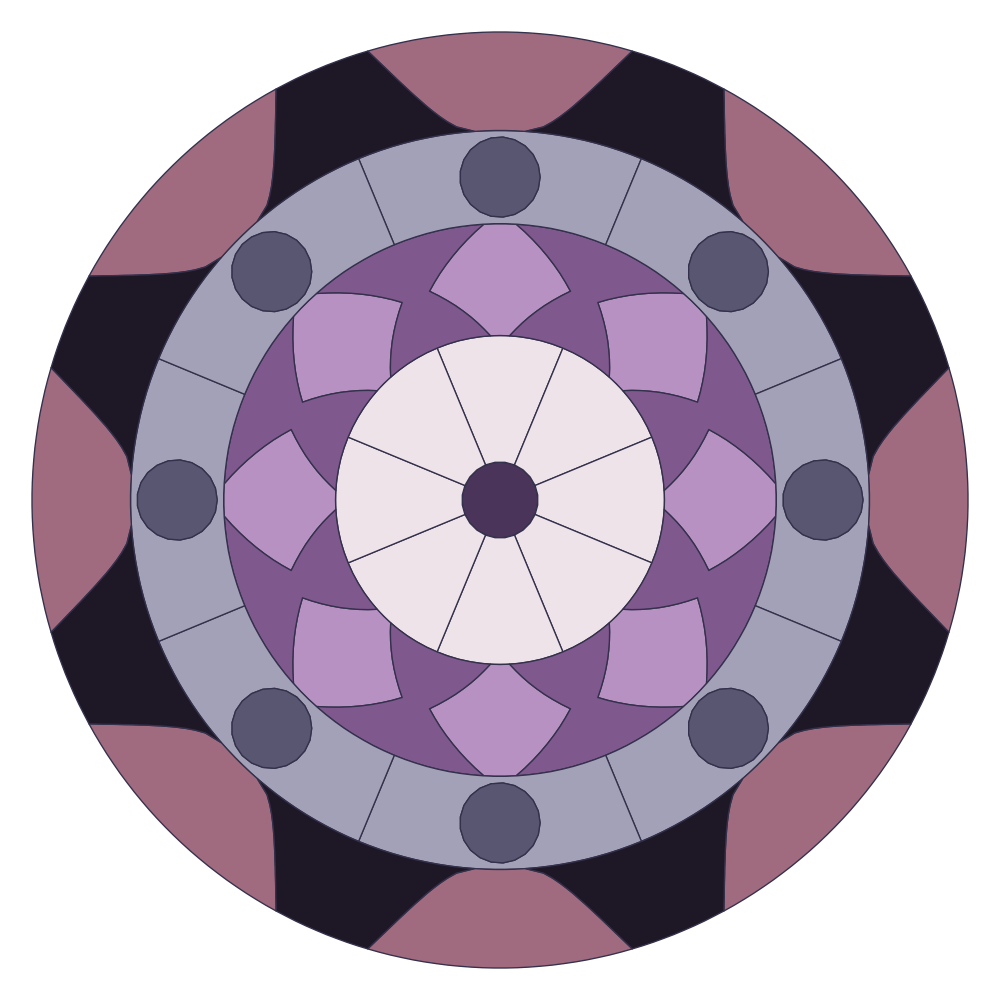
A mandala often repeats a motif around its center. Choose one visible motif and trace where it appears again. You might follow the same petal around a ring or complete one wedge from the center outward. This gives the activity a clear sequence without requiring you to plan the entire picture at once.
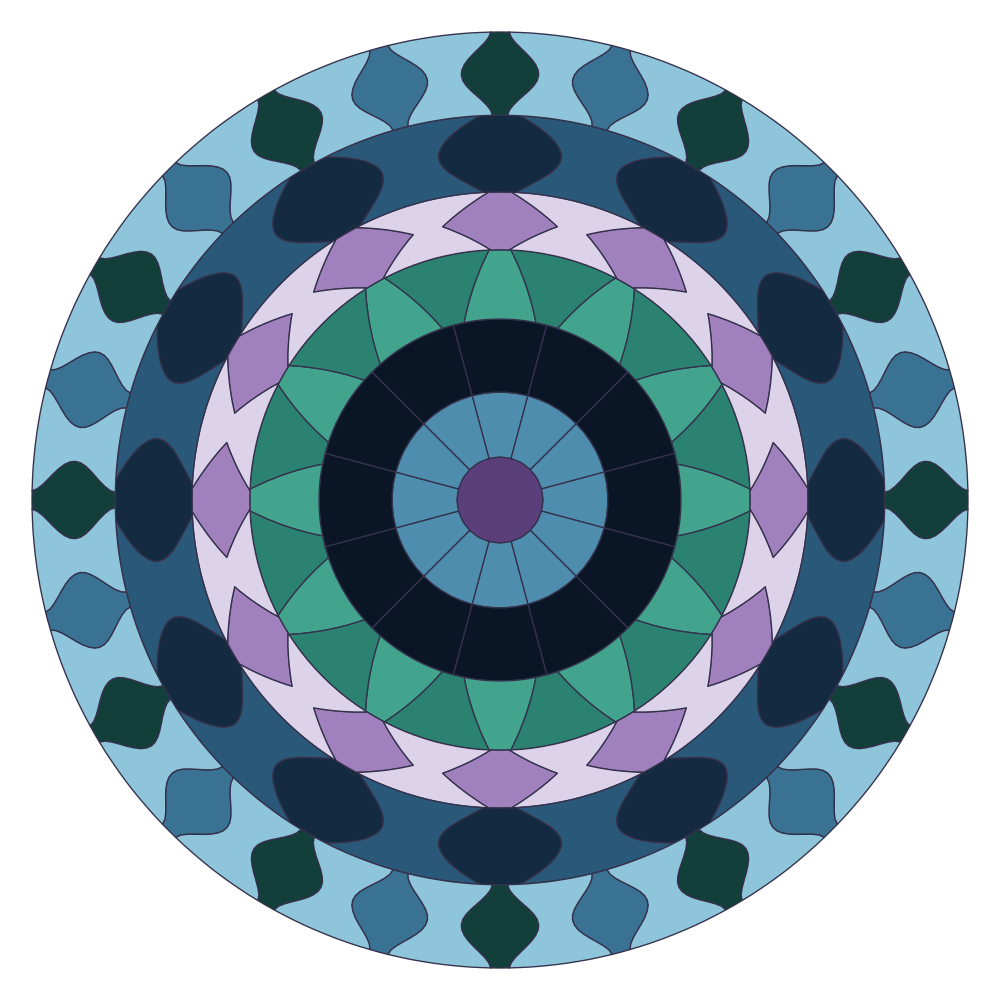
The catalogue snapshot used for this article describes Morning Lotus with eightfold symmetry and Thousand Petals with twelvefold symmetry. These are properties of the particular designs, not a ranking of which pattern is better. More repeated sectors can make individual spaces narrower, but the effect depends on the drawing. Compare the actual previews instead of deciding from one number.
Choose an approach to color
In numbered coloring, the relationship between numbers and palette colors gives you a defined route through the pattern. Your main choices are where to begin and how to move between sections. With a free coloring page, you choose the colors yourself. Check the current app and selected mode before expecting those activities to have the same controls.
If you are choosing a palette freely, start with a small group of colors you like together. Repeat them through one ring before adding another shade. You can use a darker color to distinguish a boundary and a lighter color for a larger area. This is a practical visual choice, not a claim that a particular color reveals your personality or produces a predictable emotional response.
Try one ring or one sector first
Beginning at the center is an option, not a rule. If the middle is crowded, start with an outer ring of larger shapes. Complete a few neighboring spaces and check whether you like the pace. A short trial tells you more about the pattern than a difficulty label alone.
Working around one ring emphasizes repetition. Working through one sector helps you see several layers come together. Both are reasonable. Choose the approach that makes it easy to recognize where you are. When you change direction, take a moment to locate the last completed shape so that you do not spend the next few minutes repeatedly inspecting the same area.
Notice when the pattern is asking too much
If you lose your place frequently, enlarge the view and use a recognizable landmark. If the enlarged view becomes hard to navigate, zoom out briefly to recover the whole design. If you still dislike the repeated searching, a simpler pattern may suit this session better. Choosing another picture is a useful adjustment, rather than a failed attempt.
You can also stop after completing a ring. The whole mandala does not have to be finished during the same sitting. Before closing the app, check how your current work is saved and where to find it again. Changing accounts or devices introduces a separate synchronization question; a familiar picture in the catalogue is not proof that your personal progress has arrived there.
Keep the surroundings simple
Set the screen where you can see it comfortably, choose readable brightness and make room to rest your hands. You may prefer silence or familiar background sound. Neither is required for coloring to count as a creative activity. Avoid making the setup so elaborate that beginning becomes a separate project.
A five-minute trial can be enough to choose a pattern, though it is not a prediction of completion time. If you have a fixed stopping time, decide which small part you would enjoy working on before then. The guide to coloring time and detail explores this choice in more depth, including how to use a longer session without turning it into a finishing deadline.
Find a useful second pattern
After the first session, describe what you liked in concrete terms: broad spaces, repeated petals, a strong outline or a limited palette. Use that description to choose from the Mandalia gallery. Change one characteristic at a time so you can tell whether denser detail, more sectors or a different subject makes the experience more enjoyable.
If repetition does not appeal to you, a short visual puzzle offers a different kind of activity. You can also explore the club's quiet creativity collection. A first mandala is simply a pattern you can comfortably begin and return to. Its value does not depend on finishing every section, choosing an impressive design or following a prescribed interpretation of the colors.