
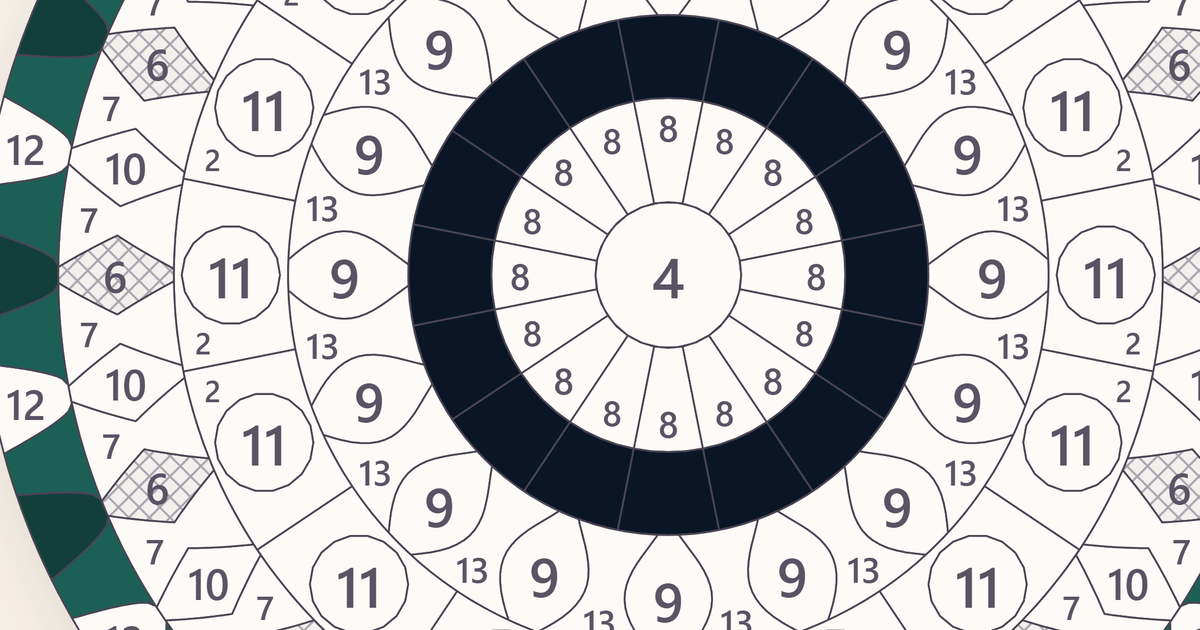
Some evenings, the best starting question is simply whether you like looking at the thing you are about to make. That question works particularly well for mandalas. A floral pattern and a geometric design can look equally inviting in a small thumbnail, yet their open boards offer quite different experiences. One draws your eye toward broad petals; the other invites you to follow bands, diamonds and the spaces between them. Looking at the actual layout helps you choose more confidently than a finished preview alone.
Here are two available Mandalia pictures: Morning Lotus and Crystal of Facets. The first is in the Simple section; the second is in Complex. Our screenshots show the live web app in Color by Number, with a whole-board view and an equally enlarged lower-right section of each picture. The regions are unfilled so you can see their boundaries. This makes it easier to choose the density you want tonight, without committing to completing a whole mandala in one sitting.
Open the board first
Browse the Mandalia gallery for pictures, then open Mandalia. In the app, choose the appropriate catalog section and a picture. On its picture screen, select the Color by Number option with Start. For this comparison, that specific mode matters. The colored preview shows a possible finished appearance; the numbered board shows the size of individual regions and how frequently one boundary meets another.
Look at the whole circle before enlarging it. Find the center, follow a ring and notice which shapes repeat. You do not have to memorize the palette or plan a route through every number. For now, ask whether your eye moves comfortably from one region to the next. An apparently broad patch in a thumbnail may contain several smaller pieces. Opening the board lets you notice those pieces before choosing your first color.
The floral example: Morning Lotus
Morning Lotus has 57 regions, eight colors and eight rays. Broad shapes repeat around its center. Inside are wide regions numbered 8, followed by petal-like outlines numbered 6, small round details numbered 3 and sweeping outer shapes. Those repeated forms give it a flower-like appearance. The pattern is still organized by symmetry: a floral character does not mean a loose drawing without a clear arrangement.
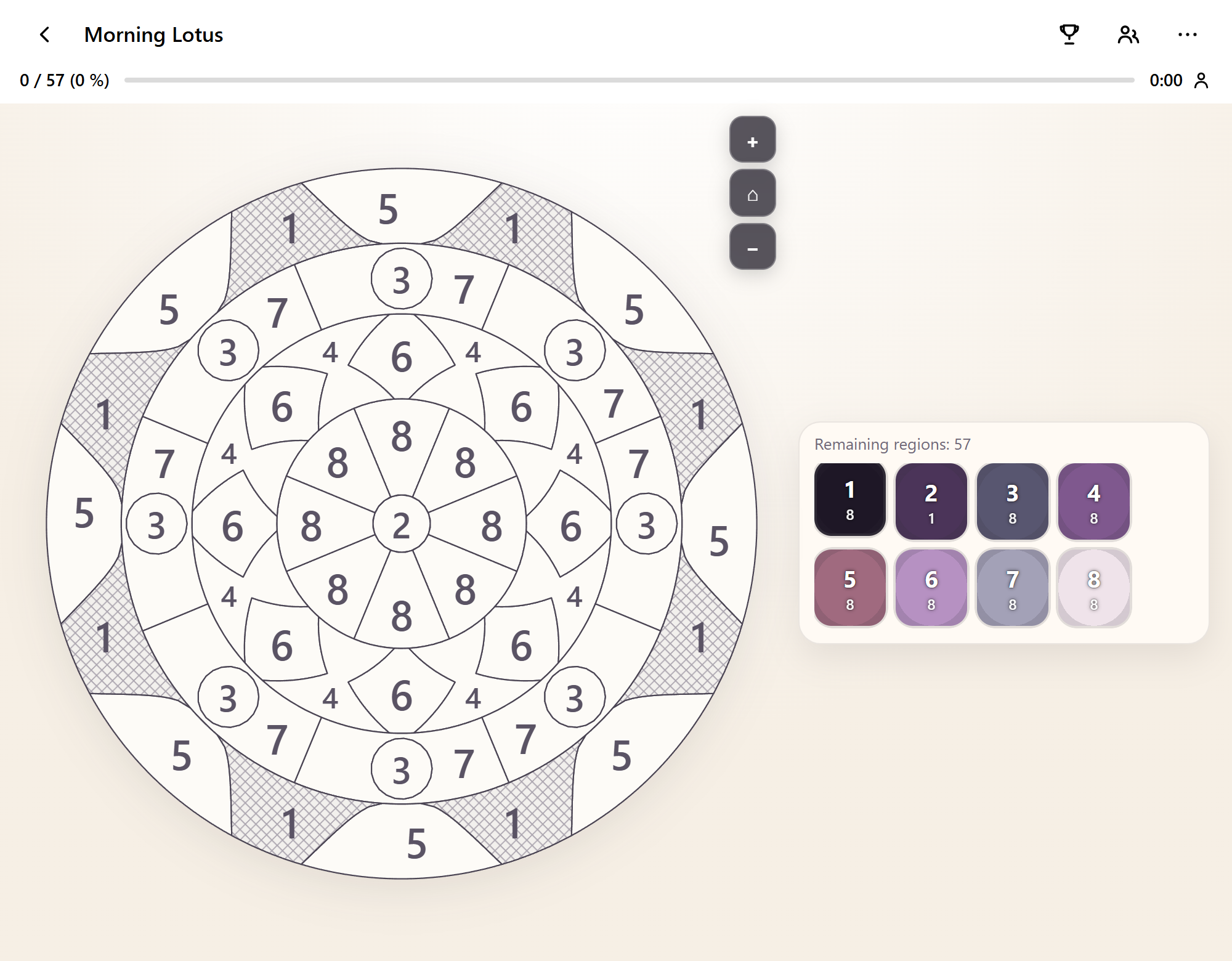
In this example, it is relatively easy to pick a noticeable region and keep it in view. Between the center and the edge are broad shapes that you can consider one at a time. If watching a whole petal or a wide part of a ring fill with color appeals to you tonight, the lotus offers that scale. Its regions are not all equally large, though. Round inserts and the spaces between shapes still call for individual attention.
The geometric example: Crystal of Facets
Crystal of Facets has 225 regions, 13 colors and 16 rays. Its outer rings are divided much more frequently, with diamonds, narrow spaces and small regions near the rim. The circle looks denser even though it occupies the same space in our screenshots. Here the interest lies in repeated short elements and in following one line to the next. This is a different arrangement of work, rather than a requirement to have artistic experience.
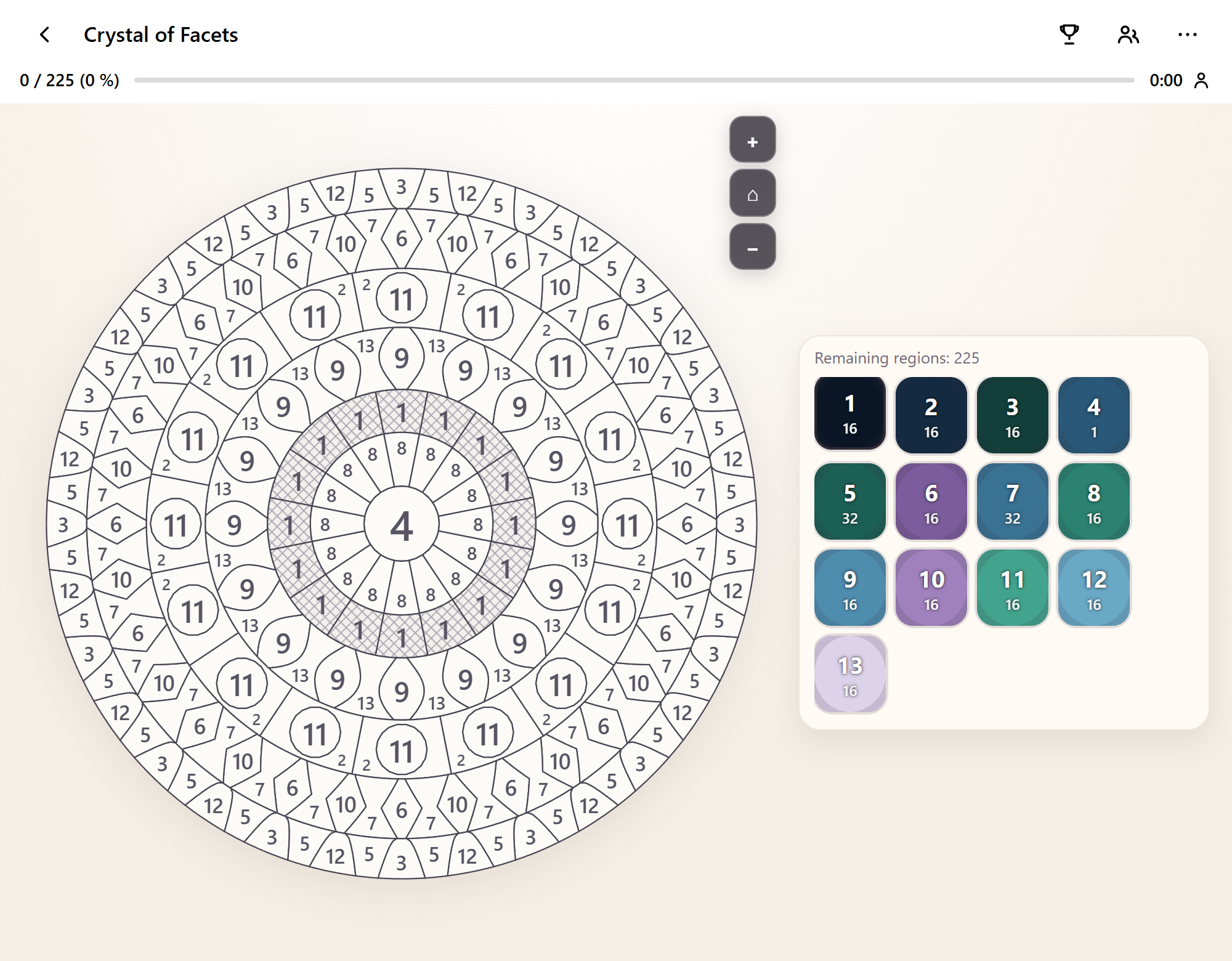
The name does not mean that every line is straight. The crystal also includes rounded and petal-like details. Its geometric character is particularly visible in the outer band of repeating diamonds. Small facets, rings and regular spacing together make this example denser than the lotus. We are comparing two particular boards. Another floral picture could have much finer details, while a different geometric design could consist of broad, simple regions.
Compare at the same scale
The two close views below show the lower-right section. Both use the same window size and the same enlargement in the app. The lotus's broad region has not been made larger by different photography. Compare how many boundaries cross a similar amount of screen space: the lotus has broader forms, while the crystal divides the space more often. This tells you more about the layout than the richness of a colored thumbnail does.
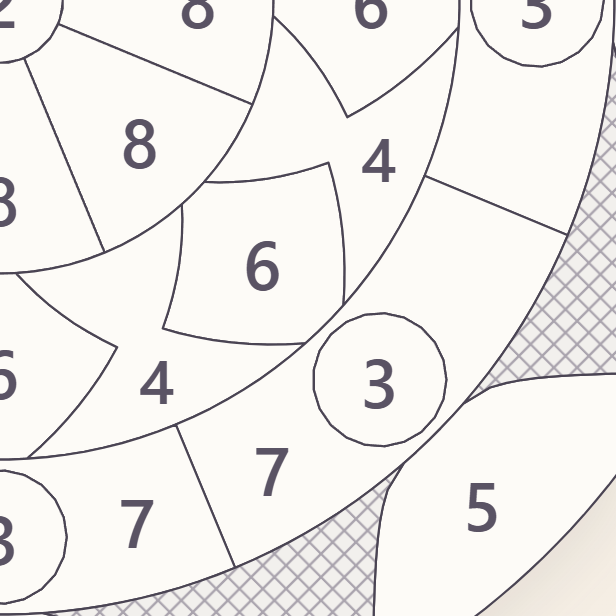
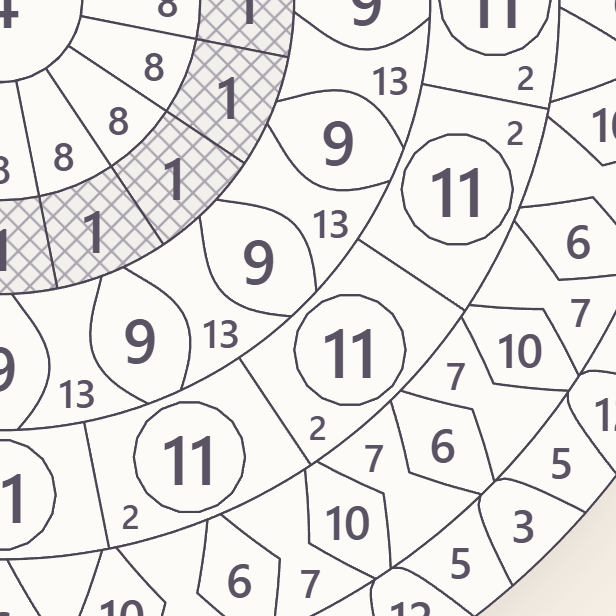
Look separately at the number inside a shape and at its edges. The number identifies a palette color, and the same number can appear in several parts of the circle. It does not prescribe an order in which you must complete the picture. Both boards contain repeated numbers, but regions sharing a number can have different outlines. The size of the printed numeral is not a substitute for the boundary; follow the enclosed shape around it.
Pick a comfortable first region
For a broad starting shape, find a lotus region whose number is clearly visible. Select that number in the palette and tap the corresponding part of the board. Then look for nearby repetitions of the same color. You can continue around a ring or stay within a section. Symmetry helps you recognize similar details, but you do not have to fill every matching region immediately or move only clockwise.
If small facets look more appealing, start with one crystal diamond or a neighboring region you can clearly distinguish after enlarging the view. Follow its outline first, then match its number to the palette. When many details look similar, enlargement helps you separate them visually. Choose a region whose boundary you understand for your first action. Selecting a complex picture does not oblige you to begin with its smallest gap.
Look past the category label
The region totals explain part of the difference: 57 and 225 are noticeably different layouts. A single number cannot describe everything, however. The widths of neighboring shapes, the frequency of boundaries near the edge and how easily you recognize a repeating motif also matter. Combining a whole view with one enlarged section is enough for this decision. You can see both the composition and the scale of the individual actions that gradually fill it.
A catalog section need not become a commitment. You can choose a simple mandala for its colors and shapes even if you have been coloring for years. You can open a complex one out of curiosity, inspect a section and choose another picture instead. Your preference for broad areas or small details may change from evening to evening. Your response to the board is more useful than trying to find a choice that should supposedly suit everyone.
One ring can be enough for tonight
Before starting, pick a small focus: one petal, a few repetitions of a color or part of the outer band. This gives your attention a direction without promising a particular completion time. You do not have to fill the whole circle to experience the difference between the patterns. A few neighboring regions may be enough to tell whether you enjoy this size of detail tonight and want to continue with it.
Return to the whole view after that first area. The lotus makes its broad repeated forms more noticeable; the crystal draws attention to individual facets within a tighter arrangement. Choose what you enjoy looking at now, and leave yourself room to stop. An evening mandala begins with a comfortable board and one clear action: trace the boundary, find the number in the palette and fill the region at your own pace.